I was actually trying to read Fragments of a Hologram Rose but the links were tied in such a way that made it inaccessible so I ended up reading Johnny Mnemonic instead. I had already seen the movie when it came out in 1995 and was only mildly interested in it. I liked the idea of being able to upload data into your brain but the story was done in such a way that it wasn't all that interesting. One of the problems I've always had with science fiction written in the early days of technology is that many writers lacked the imagination to truly envision the future. So when Johnny is bursting at the seams - so to speak - because of the multitude of megabytes in his head, I tend to scoff as I look at my 64 GB thumb-drive that is actually smaller than my thumb.
Speaking of which, why would anyone need to upload their secrets into someone else's head when they could just as easily encrypt the same data onto a secure thumb-drive? It seems a bit pointless and less than secure. After all, the data did "leak" into Johnny's brain which is what necessitated his visit to the super smart dolphin - which, in itself, is ridiculous.
I'm not sure if the entire point of this story was to delve into the super ridiculous or not. It doesn't seem like parody as it tends to take itself seriously at times. In my opinion, it just ends up a sloppy mess that doesn't make a lot of sense, presenting more questions than answers.
Saturday, November 21, 2015

Dawn
This week we were focusing on diversity in science fiction authors. I read Dawn by Octavia Butler and found it incredibly entertaining. It kept my attention and interest, making me care about the characters and relate to their struggles. It also deals with concepts that have always peaked my imagination.
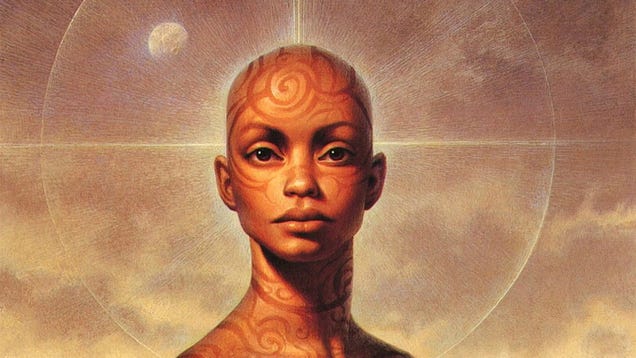
In this story, we are introduced to Lilith - one of the few surviving humans of a terrible nuclear holocaust. She is awakened 250 years after the events that destroyed life on planet Earth by a race of aliens claiming their desire to repopulate the Earth with humans. Because of their extremely different appearance, Lilith is both repelled and distrustful of her benefactors. I found this reaction to be what I typically expect most humans to do upon meeting an extraterrestrial species. Keeping in mind that the author is black and has likely experienced prejudice based on nothing more than her appearance, I found this interaction particularly honest in its approach.
One of the things that was so fascinating about this book was Lilith's slow build to trust the Oankali - the aliens that saved her. The more she gets to know the Oankali, the more she starts to realize that they are inherently more honest than humans are capable of. There are, of course, setbacks in the building of trust. Especially when she learns that there is a price to be paid for returning to Earth. She learns that their species are "traders" in genetic biodiversity. They assimilate desired genetic traits from other species into their own in order to increase their chances of survivability throughout the galaxy. The trade-off comes with a price though and essentially forces humans to take on the traits of the Oankali - resulting in a race that is neither fully human or fully Oankali. Lilith is horrified and makes plans to rebel against the Oankali once they reach Earth.
She is adopted by an Oankali "family" and given some enhancements to make her task of leading a group of human survivors to settle on Earth slightly more successful. She awakens other humans with the mission of making them ready to return to Earth. As is normal with humans, her group is distrustful of her and accuse her of being their jailor. Once they see her enhanced strength and ability to manipulate the ship, their conviction grows and further distances her from the group. Eventually, the other humans rebel against her, choosing to go their own way on Earth. As it happens, the Oankali manipulated their genetic chemistry to not only make them infertile without them but also repellant to the opposite sex. Essentially, they either willingly return to the Oankali or the human race dies out.
I'm summarizing the story of course but I highly encourage anyone to read this story. It's an interesting look at not only our own diversity but how we might react to diversity on a galactic scale.
Monday, November 9, 2015
Bloodchild
This is a story we read in class today written by Octavia Butler. It's a strange little science fiction tale where we find humans living in a parasitic relationship with an alien species. Rather than being presented with a humanoid alien of the sort that we're used to seeing in science fiction, it is a bug-like creature that sounds like a cross between a cockroach and a centipede. A really large bug at that, one who lays its eggs inside its chosen human. The downside for the humans is that if the larvae aren't removed in time, they will devour their host.
Three questions were presented to us upon having read the story.
1) Are there any prominent symbols in the story? If so, what are they and how are they used?
2) What connections did you make with the story? Discuss the elements with which you were able to connect.
3) What changes would you make to adapt this story into another medium? What medium would you use? What changes would you make?
I think it's safe to say that the question wouldn't have been asked if the answer was no. Certainly in light of the fact that there are follow up questions. As to the first question, I think the most obvious symbol is that of the egg. As we are introduced to the characters of the story, they are all sitting around their benefactor eating a sterile egg. The effects of the egg induce a euphoric state that is probably akin to being high. The only one not partaking in the egg is the mother of the human children; at least not initially and not of her own will. Then there is the laying of eggs in the hapless human, Lomas, who is in danger of being eaten alive by the young inside of him and Gan's witness of the "birth." At the end, eggs are implanted into Gan.
I didn't really make any personal connections with the story. If anything, I would say that I could probably connect with Gan's desire to protect his sister from having T'Gatoi lay an egg inside of her. I can also relate to his relationship with his older brother, even though I'm the eldest child. There is still a realistic interpretation on the artist's part in showing us their relationship that calls to mind interactions between my own brothers. Gan also takes responsibility onto himself that protects his mother and the rest of his family.
If I were to change this story into another medium I would choose computer animation, since that would allow me to create the creatures as I see them without any limitations or restrictions. I would change the story so that it was just between T'Gatoi, Gan, and his mother. I think the other siblings get in the way of the story and they don't really add anything that couldn't be substituted by the mother. T'Gatoi could have said she was going to lay her eggs inside his mother which could have elicited the same response in Gan. Also, having the older brother be witness to a birthing gone wrong isn't necessary since Gan sees a birthing gone wrong for himself. It would simplify the story without losing any of its interest. Of course, one could argue that the siblings give some humanity to the main character but I don't know that the same effect couldn't be achieved with the mother.
Saturday, October 31, 2015
First Contact Novelette

As a self-proclaimed sci-fi nerd, I dream of the day that mankind meets another traveler upon the ocean of stars. Having grown up with Star Trek, Star Wars, and various other optimistic films that showcase the everyday interactions (usually peaceful) between different species, I like to think that our first contact with an alien species will go relatively smooth. And then I think about mankind and my sense of optimism dwindles. We are largely a species defined by hate, violence, and fear; as much as we'd like to deny it.
It's telling that this story resonates so well with me in that I expect mankind to act this way. Our history is full of examples that show that we fear what we don't understand. Our species is often irrational and naive, choosing to see the world the way we want it to be rather than the way it is. Facts and objectivity are replaced with superstition and bias. Mankind is not ready yet for the responsibilities of meeting another species of people, especially if those people behave like us.
The Stone and the Flute and Magical Realism
This week I revisited one of the novels that shaped my early introduction to works of fantasy. It might have even been the first fantasy novel I ever read. It is certainly the first I can recall. It's message left a lasting impression on the young boy I was and I never forgot the story. After reading it again, I find that it's like the words of a song you barely remember, or haven't heard in ages, coming back to you when you hear it again.

One of the things that made this novel stand out to me as a youth was the sense that the world the character, Listener, lived in - was real. There are certainly fantastic elements throughout the book but Hans Bemmann writes it in a way that makes it believable and almost mundane; as though things like this happen all the time. It's a great way to escape the reality of this world and substitute it for another.
As the main character and protagonist, Listener is flawed. He makes poor choices that, at the time, seem like they are being made for the right reasons. At times, he makes selfish decisions which of course turn out poorly for him. His journey is often about trying to atone for the mistakes he's made as he does usually learn his lesson. The book is full of adventure and at each turn of the page you can't wait to see what happens next. The story covers his entire life and even his eventual death. To me, it encapsulates what magical realism is about by not sugar coating or glossing over the realities of life and by showing us that life is a journey; one that sees us change by running its course - hopefully for the better.
Mr. Potter
 For those that have read Harry Potter, it's hard to read Mr. Potter in anything other than Professor Snape's cutting tongue. His tone is instrumental in giving us an alternate observation of our young hero that informs us about the complicated world in which they all live. Nothing is ever purely good or purely evil. It's this revelation, among others, that is one of the many reasons that Harry Potter is beloved by many. However, I feel that for all its fantastic elements, the tale of Harry Potter is a coming of age story.
We first meet Harry Potter as a young boy who is being mistreated and neglected by none other than his aunt and uncle; people who we would otherwise expect to be supportive and loving. It's this relationship that helps us first sympathize with him and wish him a better future. His beginnings are the beginnings of every orphan who dreams that his parents will return and his life will somehow be more. When Hagrid arrives to whisk him away, revealing that Harry is a wizard, his (and our) dreams come true.
If that were where the tale ended, it would simply be in the realm of fantasy - perhaps even something akin to a Grimm's fairytale. But the story continues and the innocence of the beginning gives way to something darker. It shows that life isn't a fairytale and that there are real-life consequences for living it. Granted, we aren't all tormented by the specter of an evil wizard overlord-wannabe, but we all have our demons to face. Ours just don't happen to be literal...most of the time.
This shedding of the light and introduction to darkness, with the message that you have to fight against that which isn't right, is a large part of growing up that most children aren't exposed to. For the most part, we try to protect our children from the nasty things in life until we believe they're old enough to understand it. J.K. Rowling introduced us to a new way of teaching our children about the realities of growing up by introducing us to Harry Potter.
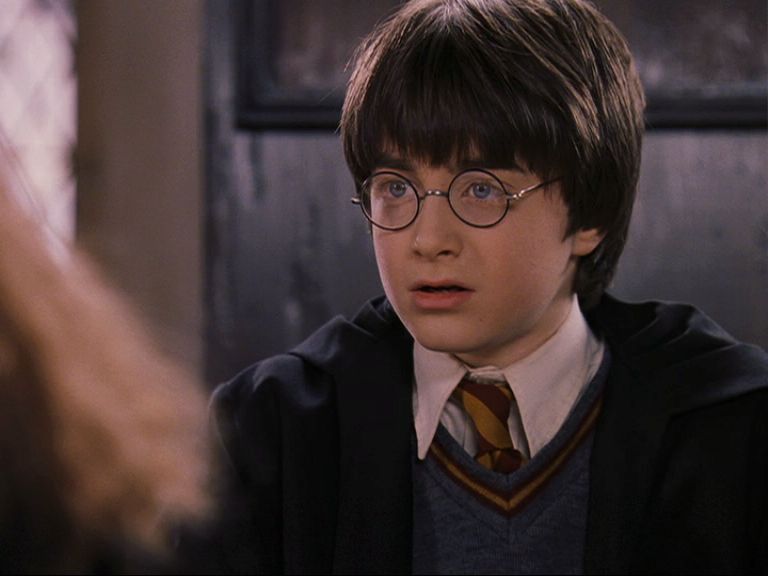 Consider the transformation of Harry throughout the series. When first we meet him, he is a fresh, innocent-looking lad whose excitement outweighs any hesitation. His attitude is naively optimistic and negative thoughts are far from his mind. Yes, there is the weight of being "the boy who lived" on his shoulders, but he's only just learned of this so its impact isn't as great. His interactions with people are generally positive and he is quick to trust.
Contrast this with the Harry we come to know by the end of Deathly Hallows. He is a battle-hardened soldier who has been forced to watch his friends and loved-ones die at the hands of Voldemort. The consequences of being "the boy who lived" have been fully realized and his attitude and optimism have changed. Even the tone of the novel changes at this point with Harry facing hard choices and adult responsibilities. He is no longer the boy we knew at the beginning, his innocence long since shattered. By the end, through his experiences, we all grow up a little. So while the setting is deeply set in the fantastic, it is - overall - a story of innocence lost.

Saturday, October 3, 2015
The Hobbit and All Things Heroic
The Hobbit reflects the classic outline of the hero’s
journey, albeit in an elaborate and rich environment. Tolkien built his tale on
the framework of the classic hero’s journey but it became so much more. The
depth he was able to reach was only possible because of the richness of his
characters. We truly believed that each was their own person, with their own
past and their own personalities. Of course, the main character is the one for
whom the book is named for, a hobbit.

Bilbo is content with his life in the Shire and sees little
reason to leave. The adventurous nature he had as a youth has all but died. It
isn’t until Gandalf arrives with the promise of adventure that the status quo
is interrupted. Staying true to the outline of the hero’s journey, Bilbo
refuses his quest and prefers to stay at home. It isn’t until the next morning,
after the troupe has left, that he realizes he has to go. The rest of the book
follows the classic points of the hero’s journey, with each trial and
tribulation escalating until the final climactic event. Bilbo learns something
about himself and the world around him. When he returns home he realizes, as
Gandalf promised him at the onset of their adventure, that he is not the same
as he was before.
Of course, Tolkien sets up the proceeding tale of Lord of
the Rings by introducing us to the One Ring and the multitude of characters
that will be of importance later. It is a tale that had such an impact on the
genre of fantasy that it is still relevant today. He introduced us to an
immersive world that many find more appealing than the everyday monotony of
real life.
Subscribe to:
Posts (Atom)